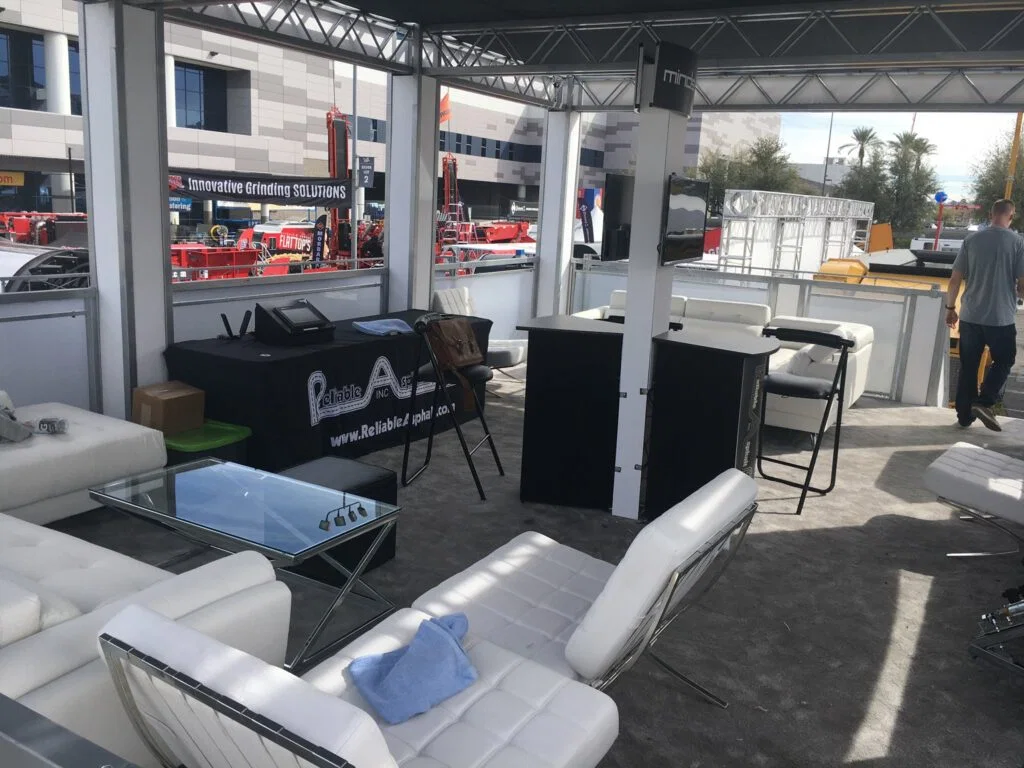
Wind is the design constraint indoors never has
An indoor booth never has to survive a gust of wind; an outdoor structure in Las Vegas has to survive several a day. Desert wind patterns around Convention Center overflow lots and Strip resort outdoor spaces can spike well past what a standard tent frame handles unmodified, so we spec ballast weight or engineered anchoring based on the structure's actual sail area rather than a generic tent rating. A large graphic panel acts like a sail in a gust, and we account for that in the ballast calculation as much as the frame rating itself.
Heat is the second constraint: direct desert sun raises interior temperatures fast, and we plan shade coverage and, where the structure allows it, ventilation into the design rather than treating climate control as an afterthought once the tent is up.
Permits before the structure ships
Outdoor space on Clark County land generally requires its own outdoor event permit separate from whatever paperwork the venue itself handles for indoor exhibit floors, and that permit process has its own lead time that does not move faster because a show date is fixed. We start the permit application early enough to absorb a review cycle, rather than assuming outdoor space clears the same way an indoor booth space reservation does.
Fire code also treats outdoor tented structures differently than indoor booths, with its own rules on flame-retardant fabric certification and clear exit spacing that we confirm against Clark County's current standards before fabrication begins.
We also keep a copy of every permit and certificate on site during the event, since an outdoor structure is more likely to see a spot inspection than an indoor booth already covered by the venue's blanket approval, and a crew unable to produce paperwork on request risks a delay while it gets sorted out.
Power without a house circuit
Most outdoor lots do not have the same built-in electrical infrastructure as an indoor hall, so power for lighting, AV, or refrigeration often comes from a generator rather than a house circuit. We size that generator to the full load, including startup surge for anything with a motor or compressor, and plan fuel logistics for a multi-day run rather than a single afternoon.
Noise and exhaust placement for a generator also matter more outdoors, where a nearby resort or a competing activation may have its own expectations about how close a running generator can sit.
What outdoor space is good for
Outdoor exhibit structures work well for vehicle displays, large-scale product demonstrations, or hospitality activations that simply will not fit inside a standard hall footprint, and venues like Hilton Lake Las Vegas Resort & Spa and outdoor lots tied to Strip South Las Vegas shows see steady demand for that kind of space during peak show season.
Staff comfort in direct desert sun
Staff working an outdoor structure through a full Las Vegas show day face direct sun exposure that an indoor booth crew never deals with, and heat can become a real safety issue by early afternoon even in cooler months. We plan shaded break areas and water access into the outdoor footprint itself, not as a separate concern staff have to solve on their own, since a crew that has to leave the structure to cool off loses coverage during peak visitor hours.
Visibility from a distance also works differently outdoors than inside a hall, and a structure that reads clearly from a parking lot or a Strip sightline needs taller, simpler branding than an indoor booth would, since there is no dense row of neighboring exhibitors focusing attention at close range.
We also plan for rapid weather response on outdoor structures, since a sudden wind advisory in the desert can require securing loose graphics or lowering a banner within minutes, and a crew without a clear weather protocol loses time deciding what to do instead of acting on it.
A written weather action plan, who lowers a banner, who checks ballast, who calls the show if conditions turn serious, travels with the crew for every outdoor event, since improvising that plan in the moment during an actual wind event is far riskier than deciding it in advance.